
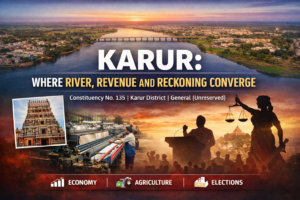
Constituency No. 135 | Karur District | General (Unreserved)
Karur does not conduct quiet politics. It measures power in margins, in market confidence, in river levels and revenue sheets. This is a constituency where enterprise is instinct, where the loom hums louder than slogans, and where one recent tragedy altered the emotional climate without turning the town into theatre.
Karur is not simply central Tamil Nadu. It is an economic engine with an ancient memory.
An Old Town That Thinks in Ledgers
Karur’s past predates party flags. Once associated with the early Chera realm, it retains inscriptions, temple corridors and trading traditions older than modern political formations.
At its spiritual core stands the Arulmigu Kalyana Pasupathieswarar Temple, a Saivite shrine whose granite pillars have outlasted dynasties. Campaign trails invariably pass its gates; devotion and democracy often share the same courtyard.
The Amaravathi River runs through the district with quiet authority. It is not decorative water; it is crop insurance, drinking supply, flood anxiety and electoral undercurrent.
Above the town rises the Thanthoni Malai Kalyana Venkataramana Swamy Temple, watching over a landscape that has grown richer and more impatient over the decades.
Karur remembers its antiquity. But it votes with contemporary calculation.
The Loom as Pulse
If one word defines modern Karur, it is textiles. Home furnishings, export houses, dyeing units and ancillary clusters form its industrial spine. This is not symbolic industry; it is globally competitive trade.
Export orders, GST compliance, freight logistics, credit cycles and uninterrupted power supply are not abstract policy debates here — they are dinner-table arithmetic.
Karur’s traders are performance voters. They ask a simple question: Does governance enable growth?
Yet prosperity has layers. Beyond town limits stretch agrarian belts dependent on irrigation schedules, input costs and crop confidence. The constituency therefore straddles two economies — industrial town and farming hinterland. Candidates must speak both languages fluently.
A disruption in one sector ripples into the other. Prosperity here is interlinked, not isolated.
Streets That Audit Governance
Karur town has expanded swiftly. With expansion has come strain.
| Urban Priorities | Rural Priorities |
|---|---|
| Road congestion & junction redesign | Canal desilting & irrigation timing |
| Storm-water drainage readiness | Rural road quality |
| Waste management systems | Primary health centre access |
| Drinking water regularity | Public distribution efficiency |
| Industrial compliance monitoring | Local employment opportunities |
Karur teaches a hard lesson: development cannot favour one geography over another. When town thrives but village feels neglected, margins shrink.
The Electoral Ledger: 2011, 2016, 2021
Karur’s recent political arc mirrors state trends while retaining its own temperament.
| Year | Winner | Party | Winning Margin |
|---|---|---|---|
| 2011 | V. Senthil Balaji | AIADMK | 24,000+ |
| 2016 | M. R. Vijayabaskar | AIADMK | ~4,000 |
| 2021 | V. Senthil Balaji | DMK | 53,000+ |
This was emphatic. The electorate did not merely endorse; it amplified.
Following the 2021 mandate, the winning MLA entered the state cabinet, handling significant portfolios. Ministerial elevation brought visibility and leverage — but also heightened scrutiny.
Power, Proximity and Courtrooms
Karur’s political narrative took a sharp turn when legal proceedings involving the sitting MLA emerged into the public sphere. Court action, arrest, prolonged legal contestation and eventual exit from the cabinet shifted the discourse from governance to accountability.
The episode became larger than an individual. It triggered statewide debate about ethics in public life, institutional processes and political narratives of victimhood versus culpability.
For Karur’s electorate, the matter carries layered implications. Some view it through the prism of legal due process. Others see it as a governance question. Either way, it has entered the constituency’s collective memory.
Karur is accustomed to strong personalities. It is less accustomed to prolonged uncertainty.
The Tragedy That Changed the Tone
Recently, a tragic incident in the district cast a shadow beyond its immediate geography. Without revisiting painful detail, it became a lightning rod in state-level debate — invoked in conversations on administrative vigilance and public safety.
Karur does not sensationalise its grief. But it does internalise it. In election cycles, such events linger. They are not decisive alone, but they sharpen the voter’s audit of governance.
Political Memory and Cadre Strength
Karur’s politics has long been cadre-driven. Organisational muscle matters. Booth-level arithmetic matters. Personal networks across trade associations, rural clusters and community bodies matter even more.
The constituency has produced figures who carried influence beyond district confines. Ministerial proximity has periodically enhanced its bargaining position within party structures.
Yet the voter’s calculus remains pragmatic: power is respected only if it translates into visible delivery.
What Moves the Voter Now
Karur approaches the next poll season through five intertwined lenses:
-
Economic Continuity
Export stability, power reliability and regulatory clarity. -
Administrative Credibility
Procedural transparency after legal scrutiny. -
Urban Discipline
Traffic flow, drainage readiness and waste control. -
Rural Assurance
Irrigation timing and procurement confidence. -
Youth Trajectories
Logistics, services, digital enterprises beyond inherited trades.
Karur’s youth are not abandoning tradition; they are expanding it.
Faith, Enterprise and the Ballot
Temple festivals draw migrant families home. Markets revive. Conversations deepen. Political campaigns align subtly with these rhythms.
Yet symbolism does not dominate indefinitely. In Karur, faith and trade coexist — but ballots are cast after balance-sheets are tallied.
The constituency respects performance more than poetry.
The 2026 Barometer
Three tests will determine the next verdict:
-
Is economic confidence intact?
-
Has governance regained moral steadiness?
-
Can opposition forces convert disquiet into consolidation?
Karur is not impulsive. When it shifts, it does so decisively. When it rewards, it does so emphatically.
Closing Note
The Amaravathi flows with measured patience. The looms hum without drama. The voter, too, watches without noise.
Karur does not shout its politics. It weighs them.
And when the ballots are opened, the constituency often reveals not just who won — but what it truly values.